
Good article by Peter S. Goodman in the New York Times (8/22/10) on “In Case of Emergency: What Not to Do”. He looks at how British Petroleum, Toyota, and Goldman Sachs handled or mishandled their recent PR debacles. On the one hand, he points out that,
“As conventional wisdom has it, the three companies at the center of these fiascos worsened their problems by failing to heed established protocol: When the story is bad, disclose it immediately — awful parts included — lest you be forced to backtrack and slide into the death spiral of lost credibility.”
On the other hand, he points out that these crises may have been so painful that there was not way to spin them and that if people understood all the awful parts early on, the reputational hit would have been even greater.
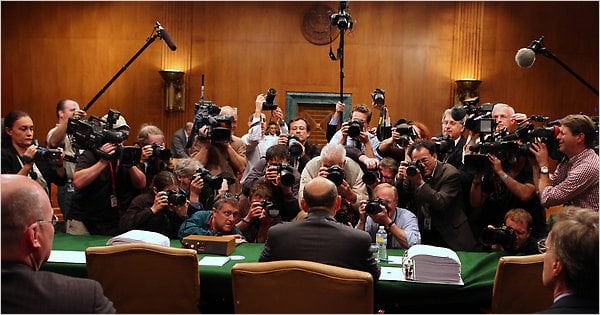
(Picture by Doug Mills – NY Times)
Be Do Say
There’s a strong argument that crisis management is one of the acid tests of integrity. When crisis management goes horrendously wrong, it’s generally because of the cover-up. Watergate was bad. But it was the cover up that cost Nixon his job. Martha Stewart broke the law. But she went to jail for covering it up. Roger Clemmons may or may not have used steroids. But he’s being indicted for perjury. Integrity is about thinking acting and talking the same all the time in line with one set of values.
Be: If British Petroleum was as concerned about the environment as it portrayed itself, it would have had a whole series of contingency plans for a blown well. If Toyota was as concerned about its customers’ safety as it portrayed itself, it would have fixed its acceleration problems years ago. If Goldman were at all concerned about its clients, it never would have put its own profitability ahead of theirs.
Do: When each of these three learned that things had gone wrong, they would have come clean and focused all their energy on fixing the problems immediately – no matter what the short term reputational cost
Say: If each of these three had been what they wanted to be and done what they should have done, the story would have taken care of itself. All they would have had to do was tell the truth. You don’t have to spin things if the truth works. Their problem was that the truth didn’t work. So they had to try to spin – unsuccessfully.
Net: Stick with your organizational vision and values, no matter what the short term hit. It’s better for everyone in the long run.